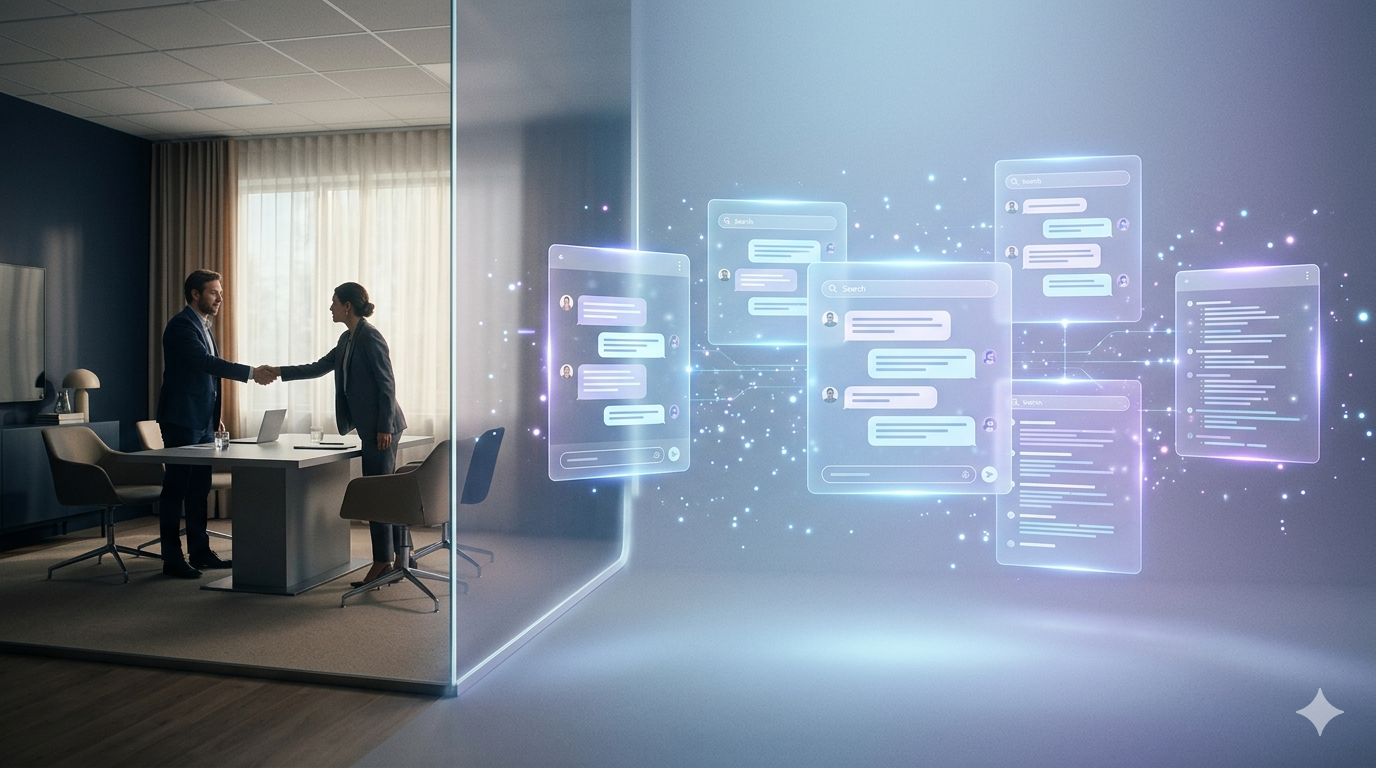

A cross-analysis of 2025–2026 B2B buyer research reveals a fundamental shift in how vendors are discovered, evaluated, and chosen — and most brands are optimizing for the wrong moment entirely.
Last month, I had to find a new SEO company for a very specific client need. I opened Perplexity and typed: “who are the best SEO companies in the US or Canada that specialize in traditional SEO, GEO and AIO, understand authority-building in a highly regulated industry?” Seconds later I had a shortlist of four.
At no point did I go to Google.
I clicked on their links. I went to their websites. I assessed them. I scheduled appointments with 3. And I selected one.
This is not an edge case anymore. And yet most B2B marketing strategies are still built around a world where buyers discover vendors through Google, nurture through content, and then talk to sales. That world hasn’t disappeared — but it’s no longer the primary path. For a growing majority of B2B buyers, the journey now starts inside an AI search tool. The shortlist is formed before your sales team knows there’s a deal. And by the time someone fills out your contact form, they’ve already decided you’re worth talking to — or they haven’t.
The question is whether your brand showed up clearly enough in those AI conversations to make the shortlist. And whether it was credible enough when they came to verify.
The Number That Should Change How You Think About B2B Marketing
Here’s what the research actually shows when you cross-reference two of the most credible data sets on B2B buying behavior.
Gartner’s time-allocation research on B2B purchasing found that buyers spend 27% of their total buying time on independent online research — and just 5 to 6% of that time meeting with any single vendor. That’s a 5:1 ratio of independent research to direct vendor interaction before a decision is made.
That ratio isn’t new. What’s new is what’s happening inside that independent research phase.
G2’s March 2026 global survey of 1,076 B2B decision-makers — covering companies from 1-person SMBs to 5,000+ employee enterprises — found that 71% of buyers now use AI search tools specifically for vendor research. Not writing emails. Not summarizing documents. Vendor research: comparing options, building shortlists, evaluating pricing, drafting RFP questions.
”For every 1 hour a B2B buyer spends with your sales team, they’ve already spent approximately 5 hours researching — and 71% of that research now happens through AI search tools.
Derived from Gartner B2B time-allocation research + G2 Answer Economy Report, March 2026 (n=1,076)
Your brand’s first impression is no longer your website. It’s not your LinkedIn profile. It’s not even a referral. For the majority of buyers, it’s an AI answer to a prompt you never saw, about a problem you didn’t know they had.
Why Everything You’ve Read About B2B Buying Behavior Might Be Wrong
Here’s something that almost never gets mentioned when people cite B2B buyer research: most of it only measures enterprise.
6Sense’s 2025 Buyer Experience Report — probably the most widely cited piece of B2B buying research right now — is based on deals with a median value of $200,000 to $300,000, with buying committees averaging 10 or more people. When that research says buyers rely heavily on prior vendor experience and use AI mostly for synthesis rather than discovery, it’s describing what happens in a $250,000 procurement process with a 13-person committee. That’s a very specific slice of the B2B market.
G2’s March 2026 data tells a different story for the rest of the market. Across SMB, mid-market, and enterprise buyers:
”33% of B2B buyers purchased from a vendor they had never previously heard of — discovered entirely through an AI search answer.
(G2, March 2026)
One in three buyers ended up with a vendor that didn’t exist in their consideration set before an AI put it there. That’s not synthesis. That’s discovery. That’s a completely different game.
69% chose a different vendor than they initially planned based on AI guidance. 51% now start their research with AI before Google — up from just 29% seven months earlier. And only 3% say AI hasn’t meaningfully changed their research habits.
The implication is uncomfortable for anyone who has built their B2B marketing strategy around brand awareness and reputation: the brand equity you’ve built over years can be bypassed by a chatbot that simply doesn’t mention you.
”The same mechanism that lifts an unknown challenger into a deal can also exclude a well-known category leader. No brand is safe from this dynamic by reputation alone.
(G2 Answer Economy Report, March 2026)
Two very different pictures of B2B buying.
| Dimension | 6Sense 2025 · Enterprise | G2 March 2026 · Broad market |
|---|---|---|
| Deal size | $200K–$300K median | SMB through large enterprise |
| Buying committee | 10+ people | 2–5 (SMB) to 20+ (enterprise) |
| AI role | Synthesis of known vendors | Discovery and comparison |
| Prior vendor experience | 85% already knew vendors | 33% bought from unknown vendor |
| AI influence on outcome | Confirms existing preferences | Changes vendor selected in 69% of cases |
These studies use different methodologies and sample compositions. The contrast is directional, not a controlled comparison.

What’s Actually Happening in Those 5 Hours
So what are buyers doing during that independent research phase? G2’s data is specific about the prompts they’re running.
They’re not easing in. They lead with commercial intent from the very first query — 33% start with a category search (“best options for X”), 31% lead with a competitor search (“alternatives to Y”). They’re already in evaluation mode before they’ve visited a single vendor website. 41% are using Deep Research tools — the kind that generate structured, multi-source evaluation reports in minutes — regularly. These aren’t casual searches. They’re thorough assessments.
And then 90% of them click through to verify what the AI told them (TrustRadius 2025).
That click-through is the moment most B2B brands are completely unprepared for. Because the buyer who arrives at your website after an AI search isn’t curious. They’re validating. They’ve already formed a preliminary view. They’re not asking “who are you?” — they’re asking “did the AI get you right? And do I feel confident enough to take the next step?”
That’s a fundamentally different job for your content to do. And it requires two things working simultaneously — which most B2B brands only deliver one of.
Your Brand Now Has Two Jobs. Most Companies Are Only Doing One.
The brands poised to win in this environment aren’t just good at marketing. They’ve figured out — consciously or not — that their digital presence needs to serve two completely different audiences at the same time.
Job One: Be AI-Legible
AI search tools can’t represent what they can’t find or parse. If your positioning is vague, your pricing is hidden, and your messaging is inconsistent across your website, LinkedIn, and review platforms, one of two things happens: you don’t appear in AI answers at all, or you appear inaccurately. Both outcomes are invisible to you and fatal to your pipeline.
What AI-legible brands do differently:
- They use specific, extractable language. “We help mid-market B2B SaaS companies reduce customer churn through retention-focused content programs” gets cited. “We help businesses grow” does not.
- They maintain complete, active profiles on G2, Capterra, and TrustRadius. 45% of buyers say review site citations are the most confidence-inspiring signal in an AI answer. These platforms are what AI trusts most.
- They publish answer-first content structured around the exact questions buyers prompt AI with — category comparisons, pricing, implementation reality, alternatives to competitors.
- They’re present in earned media and third-party sources. Ahrefs’ August 2025 analysis found that 80% of URLs cited in AI answers don’t rank in Google’s top 100 for the same query. AI citation is a different discipline from SEO.
Job Two: Make Them Feel Safe When They Arrive
This is the part that most B2B marketing misses entirely — and it’s where deals are actually won or lost.
When a buyer clicks through from an AI answer to your website, they’ve already shortlisted you. They’re not evaluating features. They’re asking themselves a much more human question: “Do I feel confident about this choice?” Neuroscience research is clear on this — humans cannot make a decision without emotional engagement. They need to be able to imagine themselves in a future state with you and feel good about it.
Most B2B websites are built to explain. They need to be built to validate.
What emotionally validating brands do differently:
- They show the humans behind the brand. Founder presence, team photos, real faces. Buyers want to know who they’ll actually work with.
- They let customers do the talking — not in polished case study PDFs, but in short videos where real people describe what changed for them and how it felt.
- They write in a human voice. 50% of buyers stop reading the moment content feels AI-generated. Authentic founder perspective outperforms polished brand copy every time.
- They make peer validation easy to find. 92% of B2B buyers are more likely to purchase after reading a trusted peer review. Reviews aren’t just for top-of-funnel — they’re the validation signal buyers look for at the decision stage.
- They remove friction from pricing and process. 74% of B2B buyers expect clear pricing upfront. Hiding it doesn’t create intrigue — it creates doubt.
What This Means for Your B2B Marketing Strategy in 2026
The shift described in this analysis is not coming. It has already happened. The buyers researching your category right now are running AI searches you will never see, forming opinions based on how clearly and consistently your brand exists across the digital ecosystem, and arriving at your website — if they arrive at all — already in validation mode.
The brands that win are the ones that show up in the AI answer and then deliver on it when the human arrives. The ones that lose are optimizing for the sales call — the last 5% of a journey that was mostly decided without them.
Three questions worth asking about your own brand right now:
- If a buyer typed your category into ChatGPT or Perplexity today, would you appear? And if you appeared, would the AI’s characterization of you be accurate?
- When that buyer clicks through to verify, does your website make them feel confident — or does it make them work to understand what you do and for whom?
- Is your brand consistently represented across your website, LinkedIn, review platforms, and earned media — or are buyers getting a different story depending on where they look?
If the honest answer to any of those is “not really,” that’s the gap. And in 2026, it’s not a small one.
”The B2B buying journey hasn’t become less human. It’s become differently human. AI handles the discovery. Humans handle the validation. Your brand needs to win both conversations — before a single sales call is ever made.
Methodology & Sources
This analysis cross-references data from multiple independent research studies to surface an insight that does not exist in any single source. Here is a complete accounting of what is confirmed versus derived.
The 5:1 Ratio — How It Was Calculated
Gartner’s B2B buying time-allocation research shows buyers spend 27% of total buying time on independent online research and 5–6% with any single vendor (27 ÷ 5.5 = approximately 5). G2’s March 2026 survey of 1,076 B2B decision-makers found 71% use AI search tools specifically for vendor research. These are separate studies with different sample compositions. The ratio is directional, not a precise empirical measurement.
Known Limitations
- Gartner’s time-allocation data skews toward enterprise purchases. Equivalent data for SMB and mid-market buyers does not exist in published research as of May 2026.
- G2’s report covers B2B software buyers. Equivalent data for non-software B2B services (agencies, consulting, fractional services) is not available at scale.
- The 6Sense and G2 studies are not directly comparable — different sample sizes, deal values, and buyer profiles. The contrast between them is illustrative, not statistically controlled.
Where the numbers come from.
| Source | Key finding used |
|---|---|
| Gartner | 27% independent research time; 5–6% single-vendor time |
| G2, Answer Economy Report | 71% use AI for vendor research; 51% AI-first; 33% bought from unknown vendor; 69% changed vendor |
| 6Sense, Buyer Experience Report | Enterprise context: AI used for synthesis not discovery in $200–$300K deals |
| TrustRadius, Buyer Trust Report | 90% of buyers verify AI answers against primary sources |
| Ahrefs | 80% of AI-cited URLs outside Google's top 100 |
| Forrester, State of Business Buying | Average enterprise buying committee: 13 internal + 9 external participants |
| G2 / Heinz Marketing | 92% more likely to purchase after a trusted peer review |
About the Author
Lara McCulloch is the founder of Start Some Shift, a Toronto-based B2B marketing agency and fractional CMO practice. She works with B2B companies to build brands that are visible, credible, and trusted — to both the algorithms that surface them and the humans who ultimately choose them. startsomeshift.com
Do you like this post?
Ready to explore how fractional leadership could transform your business?
Start Some Shift specializes in helping companies navigate exactly this transition – building flexible, powerful leadership teams that drive growth without breaking the bank. Because in uncertain times, the companies that win are the ones that deploy executive talent most strategically.