

An analysis of why information has stopped helping B2B buyers decide, and what marketing has to do to close the gap between research and commitment.
TL;DR
For every one hour a B2B buyer spends with your sales team, they’ve already spent five hours in AI search. That’s the headline finding from our earlier analysis of how modern B2B buyers actually buy.
The deeper problem is that the five hours of research don’t make buyers more confident. They make them less. Forrester’s State of Business Buying (2024) found that 86% of B2B purchases stall during the buying process and 81% of buyers regret the provider they ultimately choose. A year later, Forrester’s 2026 report based on nearly 18,000 global buyers showed why: only 36% of buyers said AI made them feel more confident in their decision, and 20% said it made them less confident because of unreliable or inaccurate information. Buyers are now demanding trials, expanding buying groups, and validating AI output against humans… all in an effort to manufacture the certainty their research was supposed to provide.
Buyers don’t stall because they have too little information. They stall because they can’t picture themselves on the other side of the decision. The buyer who can imagine the future commits. The buyer who can’t, doesn’t – no matter how good your demo was.
We call the space between I have enough information to choose and I have enough certainty to commit the Conviction Gap. It’s the most important thing happening in B2B buying right now, and almost no marketing function is built to close it.
This piece looks at why information has stopped helping, what behavioural research actually tells us about how people decide, and what marketing has to do for sales reps facing the most over-researched, under-convinced buyer in B2B history.
A buyer walks into a meeting…
Imagine the meeting. Your sales rep is across from a buyer who’s spent the last three weeks reading everything. Pricing pages. G2 reviews. Reddit threads. A ChatGPT summary of your category. By the time they sit down, they know your product better than half your employees do.
The rep does a great job. The buyer nods. Asks sharp questions. Says “this looks great, let me circle back after I align with the team.”
And then nothing.
Three weeks pass. Then six. The deal slides into “nurture.” A quarter later it closes — with someone else.
This isn’t a sales problem. Your rep didn’t fumble. The buyer wasn’t lying. Something else happened in the gap between “this looks great” and “let’s go”. Something that has almost nothing to do with what’s in your pitch deck and everything to do with what’s happening inside the buyer’s head.
We’ve written about this shift before. Last week, we published an analysis of how the modern B2B buyer actually buys, and one number became the headline everyone shared: for every one hour a B2B buyer spends with your sales team, they’ve already spent five hours in AI search. Five to one. The bulk of the decision is happening somewhere your reps will never sit.
Most founders read that and concluded they had a sales problem, or a visibility problem, or an AI problem. They don’t. Or rather, those are the surface symptoms of something deeper. The five hours don’t mean buyers know more. They mean buyers have processed more, and are still, somehow, less able to commit than ever. The volume of research has gone up. The rate at which deals close has gone down. Something in the middle is broken.
That something has a name. We call it the Conviction Gap, and it’s where most B2B deals are dying right now.

What the 2026 B2B buyer behavior data actually shows
In our first instalment on the Binary Buyer Era, we cross-pollinated buyer behavior research, AI search adoption data, and B2B sales performance benchmarks to map how buying really works in the AI era. The headline finding was the one most people focused on: for every hour a B2B buyer spends with your sales team, they’ve already spent five hours in AI search.
It misled a lot of founders into thinking they had a sales problem.
They don’t. They have a conviction problem. And the 2026 B2B sales statistics underneath the headline tell a much more uncomfortable story:
- 95% of the time, the winning vendor is already on the buyer’s Day One shortlist (6sense Buyer Experience Report, 2025). By the time someone books a call, the decision is roughly 80% locked in.
- 86% of B2B purchases stall during the buying process (Forrester, 2024). Buyers go quiet, dates slip, “internal alignment” becomes a black hole.
- 81% of buyers are dissatisfied with the provider they ultimately choose (Forrester, 2024). Even the buyers who do close are buying with regret.
- 84% of buyers want sales reps to act as trusted advisors who bring new insights, not just pitch product (Salesforce State of Sales, 2025).
Read those numbers together and a different picture emerges. Buyers are drowning in information. They’ve already made up their mind. They’re under-convinced. And nobody is helping them close that gap.
AI search closes the information gap. It does it well. It does it at scale. It does it without your sales team in the room. But information has never been what makes a buyer commit. Conviction is. And the entire structure of B2B marketing was built for a world where conviction was a side effect of a good sales conversation. That world is gone.
“The Conviction Gap is the space between "I have enough information to choose" and "I have enough certainty to commit."”
More information was supposed to help. It didn’t.
Here’s the conventional wisdom: buyers stall because they need more information:
- Better proof points.
- Sharper differentiation.
- A tighter ROI calculator.
Hand them the right facts, the thinking goes, and the decision will follow.
That logic stopped working about a decade ago. It’s now demonstrably backwards.
In 2000, two psychologists named Sheena Iyengar and Mark Lepper set up a tasting booth at a gourmet grocery store in California. Some days they put out 24 flavours of jam. Other days they put out 6. The 24-flavour booth pulled in more browsers, naturally — more variety, more curiosity. But here’s the thing. When 24 jams were on offer, only 3% of the people who stopped actually bought a jar. When there were just 6, that number jumped to 30%.
Ten times more sales. With less to choose from.
The study is called the jam study, and it kicked off twenty-five years of research showing the same uncomfortable thing: more options, more information, more research doesn’t help people decide. Often, it stops them entirely.
A 2023 study published in the Proceedings of the National Academy of Sciences pushed it further. Researchers gave participants causal models — basically decision-making diagrams — to help them choose between options. Some got simple diagrams with only the relevant paths highlighted. Others got comprehensive diagrams with everything. The participants who got the less information made the better decisions. And the ones who thought they needed all the information were the worst performers in the entire study.
Translation: more information makes people feel like they’re being more careful. It doesn’t make them more right. And it definitely doesn’t make them more decisive.
Now think about your B2B buyer. Five years ago they had a Google search and three vendor websites. Today they have ChatGPT, Perplexity, Gemini, sixteen tabs of comparison content, an AI-generated pros-and-cons grid, 30 LinkedIn recommendations, three Reddit threads, and 20 Slack channels. According to Forrester’s State of Business Buying (2026), based on a survey of nearly 18,000 global buyers, 94% of B2B buyers now use generative AI during their buying process, and AI tools have become the single most cited meaningful interaction type for researching purchases. The amount of information has gone up by an order of magnitude.
So has the rate at which deals stall.
Forrester’s State of Business Buying (2024) found that 86% of B2B purchases stall during the buying process. Not lose. Stall. The deal gets to a certain point and just stops. And of the buyers who do eventually buy something, 81% are dissatisfied with the provider they ultimately choose.
The vast majority of B2B buyers, who have access to more information than any buyer in history, are stalling on their decisions and regretting the ones they make. Information was supposed to fix this. It made it worse.
That’s the Conviction Gap, expressed as data. The information side of the bridge is fully built. The conviction side isn’t.
Buyers are trying to fix this themselves (and it’s not working)
The most striking finding isn’t that buyers are using AI. It’s how aware they’ve become that AI alone isn’t getting them to a decision.
Only 36% of buyers in the 2026 survey said generative AI made them feel more confident in their decision. 20% said it made them less confident, citing unreliable or inaccurate information. Among procurement professionals, who tend to be the most skeptical buyers in any committee, 28% said AI output had reduced their confidence and 22% said poor AI information wasted their time.
So buyers, increasingly, are doing extra work to manufacture the certainty their research was supposed to provide.
Three behaviours have spiked in the last year:
- Trials have become a risk-reduction strategy. More than 60% of B2B buyers now insist on some form of trial before committing: limited pilots, paid sandboxes, usage-based trial periods. Trials let buyers feel their way into the decision rather than reasoning their way into it. They’re a workaround for a missing emotional signal.
- Buying groups have ballooned. The typical B2B buying decision now involves 13 internal stakeholders plus 9 external influencers… 22 people total. For purchases involving generative AI features, the buying group doubles in size. Buyers report that larger groups offer broader perspectives, shared validation effort, and a better ability to secure budget. Translation: when individual conviction is impossible, distributed conviction becomes the substitute.
- Procurement is showing up early. Procurement professionals are now decision-makers in 53% of business buying cycles, engaging from the start of the process and interacting more frequently with sales reps than other buyer personas. They’re a built-in skepticism layer because the rest of the committee can’t trust their own conviction.
And then there’s this: when asked what primarily triggers them to engage with a provider, buyers in the 2026 survey more often cited interactions with industry experts than information from AI tools. The thing that finally moved them off the fence wasn’t the AI summary. It was a human voice they trusted.
This is what the Conviction Gap looks like when buyers try to close it themselves. They reach for trials. They expand committees. They lean on procurement. They go looking for human validation. None of that is making buying easier. It’s making it slower, more cautious, more elaborate. And it’s all happening because the thing that used to give buyers conviction inside a single sales conversation has been hollowed out.
What actually helps people decide (it’s not what you think)
If information isn’t the answer, what is?
This is where Robert Cialdini, the godfather of persuasion research, did something interesting. After spending forty years studying how people are influenced: reciprocity, scarcity, social proof, all the classics, Cialdini published a follow-up book called Pre-Suasion. Its core insight: the most powerful moment in persuasion isn’t the pitch. It’s what happens before the pitch — what the buyer is paying attention to, picturing, and feeling in the moments leading up to the decision.
People don’t decide based on what’s in front of them. They decide based on what’s already in their head.
Around the same time, a behavioural economist named Hal Hershfield was running an experiment that, on the face of it, had nothing to do with B2B sales. He wanted to know why people don’t save for retirement. The standard answer was: they don’t have enough information. They don’t understand compound interest. They’re too short-term in their thinking. So Hershfield tried something different.
He took young adults, sat them down at a computer, and showed them a digitally aged photo of their own face. Not a generic old person. Their face, forty years from now. He had them look at it. Talk to it. Sit with it for a few minutes.
Then he asked them how much money they wanted to put into a retirement account.
The people who saw their aged selves saved more than twice as much as the people who didn’t. Same demographic. Same income. Same access to the same information. The only difference was that one group had spent two minutes in a room with the version of themselves who was going to need that money.
The lesson, replicated dozens of times since, is this: most of us experience our future selves as strangers. The future you who has to live with the decision feels like a different person. So when we’re standing at the moment of choice, we’re not really choosing for ourselves. We’re choosing for someone we don’t quite know yet.
Now bring that back to your B2B buyer. They’ve been told, by every piece of content you’ve produced, what your product does. They’ve been shown comparison charts. They’ve been given features, benefits, ROI projections, and customer logos. What they have not been given is a felt experience of the version of themselves who already made this decision. The one who’s six months in, looking back, and isn’t worried about what they chose.
Marketing doesn’t make them feel that. The pitch doesn’t make them feel that. The demo definitely doesn’t make them feel that. So when the meeting ends and the buyer says “let me think about it,” what they’re really saying is I can’t picture myself on the other side of this yet, and until I can, I’m not moving.
Why this is hitting B2B specifically (and why now)
A reasonable business owner might read all that and think: fine, but people have always struggled to imagine the future. Why is this hitting B2B harder now?
A few reasons stack up.
- The first is committee size. As we just covered, the average B2B buying decision now involves 22 people: 13 internal, 9 external. Each person on that committee is imagining a different future self. The CFO is picturing the version of herself who has to defend the spend. The IT lead is picturing the version of himself who has to support the rollout. The end users are picturing themselves training on a new tool. None of those futures are vivid. None of them are aligned. And no committee can commit when its members are all looking at different blurry pictures.
- The second is the AI substitution problem. Buyers used to do their imagining during the sales conversation. The rep would walk them through a story: “imagine your team six months in”, and the buyer’s brain would fill in the picture. Now, that imagining gets outsourced. ChatGPT gives them the rational answer. It does not, and cannot, give them the felt answer. So the buyer arrives at the call with a head full of facts and a heart full of nothing. According to 6sense’s 2025 Buyer Experience Report, 95% of the time, the eventual winning vendor is already on the buyer’s Day One shortlist before any sales conversation happens. Which means the rep isn’t pitching anymore. The rep is auditioning to be the vendor the buyer can finally feel something about.
- The third is they’re working harder and feeling less sure. Here’s what Forrester’s 2026 data quietly confirms: even when buyers do all this extra work — the trials, the expanded committees, the procurement reviews — only 36% of them feel more confident at the end of it. The architecture buyers are building to compensate for the Conviction Gap is itself not closing the Conviction Gap.
Add it all up and you get the modern B2B buyer: over-informed, under-imagined, surrounded by people who can’t agree on the future, and being asked to commit to a version of it they can’t see. The Conviction Gap is the actual physical distance between where a buyer is when they finish researching and where they need to be to sign. And the reason that distance has gotten so wide, so fast, is that the thing that used to bridge it — a sales conversation that built a felt picture of the future — has been outflanked by AI.
No wonder buyers don’t commit.
What marketing has to do to close the Conviction Gap
Here’s where it gets uncomfortable. Because if conviction is the bottleneck, then almost everything most B2B marketing departments are producing is the wrong thing.
The white papers, the case studies, the feature comparisons, the demo videos… they’re all about your product. Your capabilities. Your differentiation. They are useful. They are also, mostly, incapable of doing the only job that matters at the decision moment, which is helping the buyer see themselves on the other side of the choice.
Three jobs have to change. None of them are about producing more.
- The first job is identity, not capability. When Hershfield aged people’s faces, he didn’t show them a chart of their retirement income. He showed them a person. The most underused asset in B2B marketing is the customer story that helps the buyer recognize themselves. Not “Acme Corp saw a 30% lift.” That’s a fact. Facts don’t help future selves feel anything. The story that does the work is “Sarah, the VP of operations at a 200-person logistics company who’d been burned by two previous platforms and was nervous about pulling the trigger on a third… here’s what she felt three months in.” That’s a future self the buyer can step into. This is where most case studies fail. They describe outcomes. They should describe identities. The 81% buyer regret stat is, at its heart, an identity-match failure. People bought from vendors they couldn’t quite see themselves in, and the discomfort caught up with them.
- The second job is portability, not collateral. Most deals don’t close in the room. They close in the meetings the rep is never invited to: the buyer explaining your product to their boss, their finance lead, their team. With buying committees now at 22 people on average, your champion is doing the lion’s share of the selling, internally, in meetings you’ll never see. According to a recurring Forrester finding, around 65% of marketing collateral never gets used by sales. The reason is that most of it can’t survive the trip from the rep’s screen to a stakeholder who wasn’t on the call. Marketing’s job is to make assets that can travel without the rep. Pieces a buyer can forward to their CFO and have it land. A Loom walkthrough they can share. A written brief they can paste into Slack. An interactive comparison their IT lead can poke at. If your champion can’t sell internally, your deal can’t close externally. And almost no B2B marketing function measures itself this way.
- The third job is frame, not feature. The best persuasion makes the rest of the data make sense. Cialdini’s work on pre-suasion is full of examples of how a single reframe: one image, one question, one comparison, changes which option a person picks before they’ve consciously thought about it.
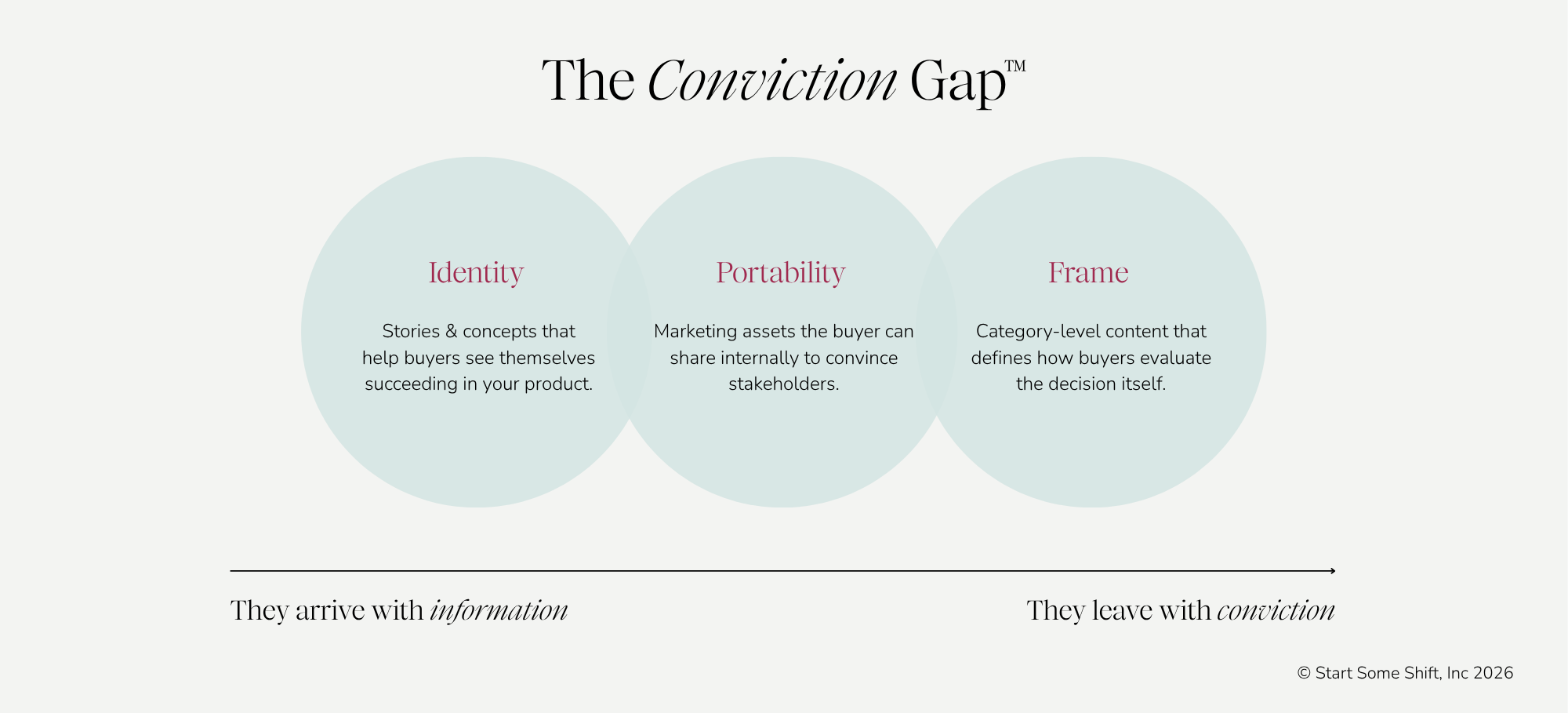
In B2B, the brand that owns the frame — the way the category is talked about, the criteria buyers use to evaluate it, the questions a sophisticated buyer should be asking — owns the shortlist. The frame is what AI search picks up. It’s what the champion uses internally. It’s what the buyer carries into the future-self moment. And almost no B2B brand is investing in it the way they’re investing in features.
These three jobs: identity, portability, frame, are how marketing closes the Conviction Gap. They aren’t replacements for capability content. They sit on top of it, doing the work that capability content was never designed to do.
Why this is an owner problem, not a marketing problem
You can hire a great marketing leader and still get this wrong. Most B2B marketing functions are structured to fill the funnel, not close the Conviction Gap. They’re measured on volume, not on whether the buyer left the deal feeling certain.
Fixing this requires an owner-level decision about what marketing is for. If marketing’s job is lead generation, you’ll keep producing facts. You’ll keep watching deals stall at the same stage. You’ll keep being mystified by your win rate.
If marketing’s job is conviction, the entire function reorganizes. Content strategy shifts from volume to identity, portability, and frame. Success metrics shift from MQLs to “deals where marketing material was used in the close.” Brand work shifts from awareness to category authority and identity-match proof. Sales enablement stops being a collateral library and becomes a small set of deeply-built assets reps actually deploy.
This is the work most B2B fractional CMOs and marketing leaders are not doing because they were trained on a buyer who no longer exists. The buyer who needed information and a pitch. That buyer is gone. The new buyer needs to feel a future. The marketing function that delivers that wins.
The shift
Let’s recognize the Conviction Gap for what it is — a structural shift in how buyers commit, caused by the same AI search that was supposed to make buying easier, and bridgeable only by the kind of marketing that makes a buyer feel something true about their future. AI search has made facts free. What it hasn’t made free is the felt sense that you’ve made the right call.
That’s still the work. It’s still the only work. And it’s the marketing function’s job to do it.
Information used to be the bottleneck. AI took care of that. Conviction is the bottleneck now. The Conviction Gap is the work. Close it, or watch your competitors close it for you.
Frequently Asked Questions
Why do B2B deals stall in 2026?
The most cited reason is internal stakeholder misalignment, but the deeper cause is what we call the Conviction Gap — the space between having enough information to choose and having enough certainty to commit. Forrester’s 2024 State of Business Buying report found 86% of B2B purchases stall during the buying process. Forrester’s 2026 follow-up showed why: only 36% of buyers said AI made them feel more confident in their decision, and 20% said it made them less confident. Behavioural research from Hal Hershfield and others shows that the inability to vividly imagine a future self is one of the strongest predictors of decision delay, and modern B2B buyers — drowning in AI-generated information — are getting less of that imaginative help than ever.
What is the Conviction Gap?
The Conviction Gap is the space between I have enough information to choose and I have enough certainty to commit. AI search closes the information gap. Marketing has to close the conviction gap. The gap explains why B2B buyers are now demanding trials, expanding buying groups, and validating AI output against humans — all in an effort to manufacture the certainty their research was supposed to provide.
Why doesn’t more information help B2B buyers commit?
Research dating back to the 2000 Iyengar-Lepper “jam study” shows that more options and more information often reduce the rate at which people make decisions. A 2023 study in the Proceedings of the National Academy of Sciences found that participants given simpler, more targeted information made better decisions than those given comprehensive data — and that participants who believed they needed everything performed worst. Forrester’s 2026 data confirms the same pattern in B2B: 94% of buyers now use AI in their research, but only 36% feel more confident as a result.
What is buyer indecision in B2B sales?
Buyer indecision is the state in which a B2B buyer has gathered enough information to choose but lacks the confidence to commit. It’s distinct from objection or competitor loss; the deal doesn’t die, it stalls. Forrester’s 2026 State of Business Buying report shows buyers now use trials, expanded buying committees (averaging 22 people), and procurement involvement (now decision-makers in 53% of cycles) to compensate for this lack of conviction — and still struggle to reach decisions.
How can marketing help sales close deals with informed buyers?
Marketing has to close the Conviction Gap by shifting from capability content (features, comparisons, ROI calculators) to three different jobs: identity (stories that help the buyer see themselves succeeding), portability (assets the buyer can use to sell internally without the rep), and frame (category-level thinking that owns the way the decision is evaluated).
What is the psychology of B2B buying decisions?
Modern B2B buying decisions are governed less by rational evaluation and more by the buyer’s ability to imagine themselves on the other side of the commitment. Research from Robert Cialdini (pre-suasion), Hal Hershfield (future-self continuity), and Sheena Iyengar (choice overload) all point to the same conclusion: people decide based on what they can picture and feel, not what they can prove. Forrester’s 2026 finding that buyers more often cite human industry experts than AI as the trigger for engaging a provider supports the same point — humans build conviction, AI doesn’t.
Sources & further reading
- Iyengar, S. & Lepper, M., Journal of Personality and Social Psychology, 2000 — the jam study
- Hershfield, H. et al., Journal of Marketing Research, 2011 — future-self continuity and intertemporal choice
- Cialdini, R., Pre-Suasion: A Revolutionary Way to Influence and Persuade, Simon & Schuster, 2016
- Mayrhofer, T. et al., Proceedings of the National Academy of Sciences, 2023 — less is more in causal models
- Forrester, State of Business Buying, 2024 — 86% stall, 81% regret
- Forrester, State of Business Buying, 2026 — based on the 2025 Buyers’ Journey Survey of nearly 18,000 global buyers; AI confidence findings, buying group size, trial adoption, procurement involvement
- 6sense, Buyer Experience Report, 2025 — Day One shortlist, LLM usage

About the Author
Lara McCulloch is the founder of Start Some Shift, a Toronto-based B2B marketing agency and fractional CMO practice. She works with B2B companies to build brands that are visible, credible, and trusted — to both the algorithms that surface them and the humans who ultimately choose them. startsomeshift.com
Do you like this post?
Ready to explore how fractional leadership could transform your business?
Start Some Shift specializes in helping companies navigate exactly this transition – building flexible, powerful leadership teams that drive growth without breaking the bank. Because in uncertain times, the companies that win are the ones that deploy executive talent most strategically.