

The honest breakdown of fractional CMO pricing, and why most companies under $20 million in revenue shouldn’t be hiring a full-time CMO at all.
How much does a fractional CMO cost in 2026?
In 2026, a fractional CMO costs $5,000 to $15,000 USD per month for most engagements in the United States, and CAD $6,000 to CAD $13,700 per month for most engagements in Canada. Hourly rates run $200 to $500 USD or CAD $275 to $685, depending on experience and specialization. Larger or more embedded engagements — typically with companies above $50M in revenue or PE-backed portfolio companies — can run $15,000 to $50,000 USD per month.
That’s the answer most people are looking for when they search this question.
But after running fractional CMO engagements for B2B service businesses for years, I’d argue you’re asking the wrong question.
The right question is whether you should be hiring a full-time CMO at all. And for the vast majority of B2B service businesses under $20 million in revenue — which is who I work with — the answer is no.
I’ll explain why below. But first, the pricing.
Fractional CMO pricing models: hourly, retainer, project, hybrid
There are four pricing models you’ll encounter. Each one suits a different situation.
1. Hourly rates: $200 to $500 USD ($275 to $685 CAD)
The hourly model is mostly used for short-term, advisory-style engagements — workshops, audits, second opinions on a strategy already in play. Standard mid-tier fractional CMOs (10 to 15 years of experience) charge $200 to $350. Senior practitioners with 20+ years and a track record of scaled exits charge $300 to $500. Specialists in B2B SaaS, fintech, or PE portfolio work can charge $400 to $750.
This model is rare for ongoing work, and for a good reason. A fractional CMO billing by the hour makes more by working slower. Most experienced fractionals avoid it for engagements longer than a few weeks.
2. Monthly retainer: $5,000 to $15,000 USD (CAD $6,000 to $13,700)
This is the dominant model. The retainer covers a defined level of strategic involvement — typically two to four days per week of attention, depending on the price tier. At $5,000 to $7,000 per month, you’re getting roughly two days per week of strategic and leadership work. At $7,500 to $12,000 per month, it’s closer to three days per week with some team management. At $12,500 and up, it’s a near-CMO-level commitment with hands-on involvement in campaigns, hiring, and revenue accountability.
For context, my own engagements at Start Some Shift run between $7,000 and $15,000+ per month, depending on the scope and the client’s situation. That’s the standard-to-premium range, and it’s where most experienced B2B fractional CMOs price themselves.
3. Project-based fees: $15,000 to $50,000+ flat
For defined scopes — a rebrand, a go-to-market launch, a category positioning project — flat fees are common. The advantage is predictability for both sides. The disadvantage is that scope creep is structurally invisible, and most projects of this size benefit from the strategic continuity a retainer provides.
4. Hybrid / equity-based: $3,000 to $5,000/month + 0.5 to 2% equity
Common at seed-stage startups where cash is constrained and the fractional CMO is willing to take a pay cut for upside. This works when both parties are clear-eyed about the equity actually being worth something. It usually doesn’t work when either party is in denial about the company’s odds.
If you’re a B2B service business owner reading this, the equity model probably isn’t relevant to you. The retainer model almost certainly is.
Why is fractional CMO salary data so inconsistent?
If you’ve already searched this question and ended up confused, this is probably why.
ZipRecruiter reports the average US fractional CMO salary at $111,632. Glassdoor reports $154,367. Salary.com reports $173,180. None of these are wrong, exactly. But none of them are the actual answer to “what does a fractional CMO make.”
Salary databases capture W-2 employees. The vast majority of fractional CMOs are 1099 contractors or run incorporated consultancies. They don’t appear in salary surveys at all, except indirectly when a hiring company posts “fractional CMO” as a job title for what is usually a part-time employee position — which is a different thing.
The gap between what databases report and what fractional CMOs actually make is large. An experienced fractional CMO running three to five simultaneous client engagements at $10,000 per month each grosses $360,000 to $600,000 annually before expenses. Top-tier specialists with PE-portco engagements can clear $1M+. The databases don’t see any of that because none of it flows through W-2 payroll systems.
What this means for you, the buyer: the rate you’re being quoted is not “a salary.” It’s a price for senior strategic leadership delivered by someone who is, almost certainly, also serving other clients. That’s not a flaw in the model. It’s the entire point — pattern recognition across multiple companies is one of the things you’re actually paying for.
The full-time CMO cost you don’t see.
Almost every “how much does a fractional CMO cost” article frames the comparison against a full-time CMO base salary. This is dishonest, or lazy, or both.
The base salary is not the cost. The cost is the salary plus everything attached to it.
What a full-time CMO actually costs in 2026
| Cost component | US (USD) | Notes |
|---|---|---|
| Base salary | $190,000 – $373,000 | PayScale to Salary.com range |
| Bonus (25–50% of base) | $75,000 | Tied to revenue / pipeline targets |
| Benefits & payroll taxes | $75,000 | 28–35% of base in the US (BLS, 2025) |
| Equity / long-term incentives | $50,000+ | 0.5–2% of company value at growth stage |
| Recruiting fees (amortized) | $25,000 | 20–25% of first-year salary, spread over hire length |
| Severance reserve | $25,000 | Most growth-stage CMOs negotiate severance clauses |
| Total annual employer cost | $275,000 – $500,000+ | At enterprise tech: $700K–$1M+ |
In Canada, the base salary is lower (CAD $140,000 to $175,000 nationally) but the loaded cost is similar in structure: add CPP, EI, EHT, provincial contributions (especially in Quebec, where QPIP and Health Services Fund add to the load), benefits, equity, and recruiting. Total annual employer cost for a Canadian growth-stage CMO is typically CAD $230,000 to $400,000.
What a fractional CMO actually costs in the same comparison
| Cost component | US (USD) | Notes |
|---|---|---|
| Annual retainer (at $10K/mo standard) | $120,000 | Equivalent strategic horsepower |
| Bonus | $0 | Not part of fractional engagements |
| Benefits & payroll taxes | $0 | 1099 contractor, no employer-side load |
| Equity | $0 | Optional, structured into hybrid model if used |
| Recruiting fees | $0 | n/a |
| Severance reserve | $0 | 30-day notice in most contracts |
| Total annual cost | $120,000 | 50–75% saving vs. full-time |
The savings figure is real. But the savings is not the most important number on this page. The next one is.
The hidden cost most owners never calculate: the four-year CMO cycle.
Here’s the part of the math nobody talks about until they’re already two CMOs deep into a five-year run.
Spencer Stuart has tracked CMO tenure at large US companies since 2008. In their most recent report, the average tenure of a CMO at a Fortune 500 company is 4.1 years — the shortest stretch on record. CFOs stay 4.7 years. CEOs stay 7.6 years. The CMO is the seat at the table that empties first.
That’s the average. The other relevant number is the failure rate: 42% of full-time CMO hires fail within 18 months, according to research from Geisheker & Associates surveying 500+ companies. They’re either terminated or they leave because the role wasn’t what they were promised. Almost half. Coin-flip odds.
Stack the two facts: a 42% chance the hire fails inside 18 months, and an average of just over four years if they don’t. In practice, a business making a full-time CMO hire is signing up for the recruiting + onboarding + ramp-up + replace cycle every three to four years.
Let me show you what that costs in real dollars over a decade.
The 10-year CMO turnover cost calculation
Assume your business hires a full-time CMO at $300,000 base ($425,000 fully loaded). Industry-average tenure means you’ll make this hire two and a half times over a decade. Each cycle costs:
- Recruiter fees (20% of first-year salary): $60,000 per hire
- Six months of strategic dead air during the search: worth approximately $150,000 in lost or delayed marketing decisions for a $10M business
- Six-month onboarding ramp before they’re productive: approximately half their first-year cost, or $212,500
- One in two hires fails within 18 months, triggering severance and a second search cycle
Multiply that across 2.5 hire cycles in a decade, and the true cost of running a full-time CMO at a B2B service business isn’t $300K per year. It’s closer to $475K per year once you amortize the turnover, the failed hires, and the strategic dead air.
Now look at the fractional alternative. The average fractional CMO engagement lasts 71 months — almost six years (Geisheker & Associates, 2026). 91% of fractional CMO clients report being satisfied with the engagement, compared to that 42% failure rate on the full-time side.
The fractional engagement isn’t just cheaper. It’s structurally more durable. Fewer ways to fail. Longer continuity. No turnover cycle.
This is the math my clients see when they actually run the numbers. It’s also why most of them don’t go back to full-time once they’ve experienced fractional. (For a deeper look at the executive turnover problem and how fractional is reshaping the math, see The $175K Question: Why Smart Businesses Are Cutting Executive Costs by 50%.)
What you actually get for $10K/mo vs $400K/yr — the true scope comparison.
The cost-comparison table above shows you the dollars. It doesn’t show you what those dollars actually buy. This is where the comparison gets interesting.
What a $400K full-time CMO delivers
A full-time CMO is, on paper, a senior leader giving you their full attention. In practice, here’s what that translates to in a B2B service business:
- One person’s pattern recognition. They’ve worked at a finite number of companies. The strategies they bring are the ones they’ve personally seen succeed.
- 40 hours per week of capacity, but maybe 60% of that is productive strategic work. The rest is meetings, internal politics, agency management, hiring conversations, and the kind of administrative coordination that comes with being on payroll.
- One playbook deeply. Whatever industry and stage they came from, they’re now applying that lens to your business. If their last role was at a Series B SaaS company and you run a 20-person consulting firm, the translation is real work.
- Long ramp. Most full-time CMOs need three to six months to understand your business, your market, your team, and your data well enough to make confident decisions. Until then, they’re learning, and you’re paying the same rate.
- Long unwind. When the engagement ends — voluntarily or not — you’re back to square one. Severance, search, ramp, repeat.
What a $10,000-per-month fractional CMO delivers
For roughly a third of the cost, a different shape:
- Pattern recognition across multiple companies, simultaneously. A fractional CMO running four or five clients in parallel sees the same problem solved different ways every week. The strategies they bring you have been pressure-tested across more contexts than any single full-time CMO can match.
- Two to four days per week of strategic attention, almost all of it productive. They’re not in your internal meetings, your performance reviews, your office politics. The hours you pay for are spent thinking about your business.
- Multiple playbooks, applied selectively. A good fractional CMO has worked across industries and stages and pulls from whichever experience is most relevant to your current bottleneck.
- Short ramp. Fractional CMOs are professionally fast at understanding new businesses — they do it for a living. Most are productive on strategy decisions inside the first month.
- Designed-in flexibility. Engagement scopes can scale up, scale down, or wind down with 30 days’ notice. There’s no severance reserve, no replacement cycle, no executive search.
What you don’t get from a fractional CMO
In fairness, here are the trade-offs most articles skip:
- Daily presence. A fractional CMO isn’t in your office or your daily standups. If your business needs a marketing leader who is genuinely embedded in day-to-day operations, fractional may not give you that.
- Sole focus. Your fractional CMO has other clients. That’s structurally what makes the model work, but it means you’re sharing their attention.
- Direct people management at scale. A fractional CMO can manage a small marketing team well. Once you have a team of 10+ marketers reporting to one leader, you’re usually past the point where fractional alone is enough.
- The relationship continuity of a long-term hire. A fractional CMO who’s been with you for five years is closer to a partner than an employee. That has its own value, but it’s a different kind of value.
For more on how to figure out whether you actually need a fractional CMO, a marketing agency, or a brand strategist — and where the differences live — see Fractional CMO vs Marketing Agency vs Brand Strategist – What Do You Need, and When?
Two case studies: what fractional actually looks like in practice.
The numbers are abstract until you see them in action. Here are two examples from B2B service businesses I’ve worked with at Start Some Shift.
Case 1: Spakinect — defending the premium position
Spakinect created the telehealth Good Faith Exam category. They operated for years as the only option, then competition arrived. New players moved fast and cheap. One competitor went from zero to over 4,000 Google reviews in a single year — through review manipulation, not earned trust.
Paulina Riedler, Spakinect’s CEO, was facing a familiar pressure: hold the premium position and risk losing clients to cheaper alternatives, or race to the bottom and abandon what made them worth choosing. She needed senior marketing leadership. She didn’t need it five days a week, full-time, on payroll.
Here’s what she said about why she chose fractional: “I was looking for an option that was cost-effective, and brought in experts — people who know a lot more than I did that would move the needle. To now receive compliments from big players in the industry that they love what we’re doing — you can’t put a dollar figure on that.”
What we delivered, on a fractional engagement:
- More than doubled inbound leads from marketing, even under rising competitive pressure
- Tripled leads through paid ads while cutting cost-per-lead by 73% and cutting CAC in half
- Grew 90-day video views from 7,200 to 217,000 — a 30x increase
- Secured national media placements on CBS, ABC, and Fox
- Built a category-leadership position that competitors with 4,000 fake reviews couldn’t dent
The cost of that engagement was a fraction of what a full-time CMO of equivalent seniority would have cost. The result is that Spakinect didn’t just defend the premium position — they made the bottom irrelevant.
Read the full Spakinect case study →
Case 2: Barker Hutchinson — from limited visibility to the name in workplace investigations
Barker Hutchinson owned regulatory investigations. Decades of reputation, rock-solid track record. They wanted to expand into workplace investigations — an entirely different market with different buyers, different channels, and where Barker Hutchinson had virtually no presence.
This is the kind of project where a full-time CMO hire makes some sense on paper. It’s also exactly the kind of project where the four-year tenure problem and the long ramp time would have killed momentum. The market opportunity needed to move fast.
Working as their fractional marketing leadership, we made one bold positioning decision (specializing in Trauma-Informed Workplace Investigations) and built the engine around it. Within a year, Barker Hutchinson became the name people associated with progressive and defensible investigations.
The numbers, in under twelve months:
- 0 to 2,000+ qualified prospects in under six months
- 963% increase in webinar attendance (peaks of 250 to 600 attendees per webinar)
- 61% average open rate on email campaigns, driving 4,000 website sessions from email alone
- Brand-to-category-leader transformation in a conservative industry
Greg Hutchinson, Co-CEO, on the experience: “Now, it feels like we are light-years ahead of where we were. Working with Start Some Shift, we’ve significantly increased our reach in the first year, referral volume is up, and our branding is on point.”
Read the full Barker Hutchinson case study →
These are the kind of outcomes that justify the fractional cost. A full-time CMO at $400K/year couldn’t have moved faster. They probably would have moved slower.
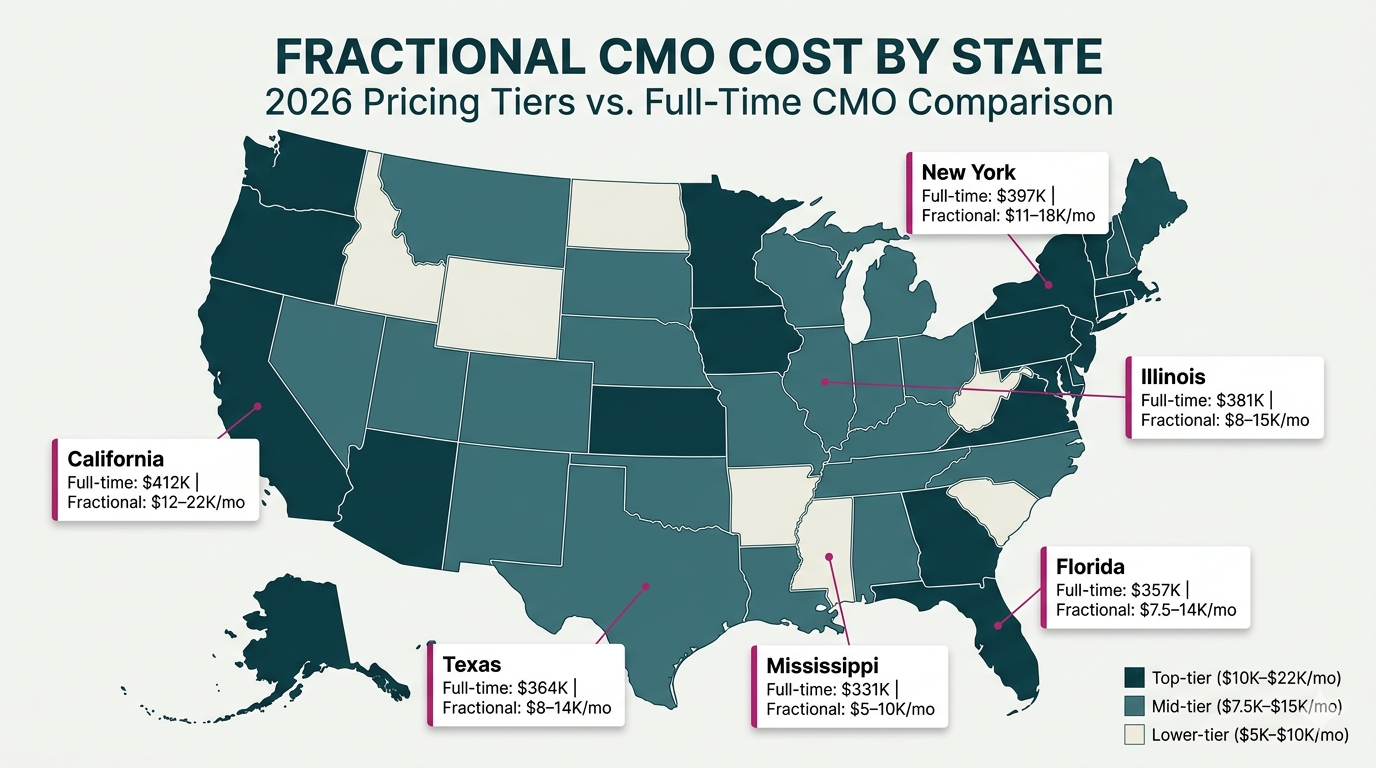
How much does a fractional CMO cost in your state? (US)
Fractional CMO pricing varies less by geography than full-time CMO pricing because most engagements are remote in 2026. Still, location matters at the edges.
Top-tier states (fractional retainer typically $10,000–$20,000/month)
- California — full-time CMO avg $412,091; fractional retainers $12,000–$22,000/month
- District of Columbia — full-time avg $413,660; fractional $12,000–$20,000/month
- Massachusetts — full-time avg $406,599; fractional $11,000–$20,000/month
- Washington — full-time avg $405,104; fractional $11,000–$18,000/month
- New York — full-time avg $397,184; fractional $11,000–$18,000/month
- Connecticut — full-time avg $399,276; fractional $10,000–$17,000/month
- New Jersey — full-time avg $404,955; fractional $10,000–$17,000/month
Mid-tier states (fractional retainer typically $7,500–$15,000/month)
- Colorado — full-time avg $381,193; fractional $8,000–$15,000/month
- Illinois — full-time avg $380,820; fractional $8,000–$15,000/month
- Texas — full-time avg $363,500; fractional $8,000–$14,000/month
- Georgia — full-time avg $358,900; fractional $7,500–$14,000/month
- Florida — full-time avg $357,400; fractional $7,500–$14,000/month
- Pennsylvania — full-time avg $371,928; fractional $8,000–$14,000/month
- Virginia — full-time avg $376,224; fractional $8,000–$14,000/month
- North Carolina — full-time avg $356,100; fractional $7,000–$13,000/month
Lower-tier states (fractional retainer typically $5,000–$10,000/month)
Most southern, midwestern, and rural states — full-time CMO avg $331,000–$355,000; fractional retainers $5,000–$10,000/month.
The state you’re in matters less than you’d think. Most experienced fractional CMOs work remotely and serve clients across states. The state-level data above is more useful as a reference for what a “fair” rate looks like in your local talent market than as a hard constraint.
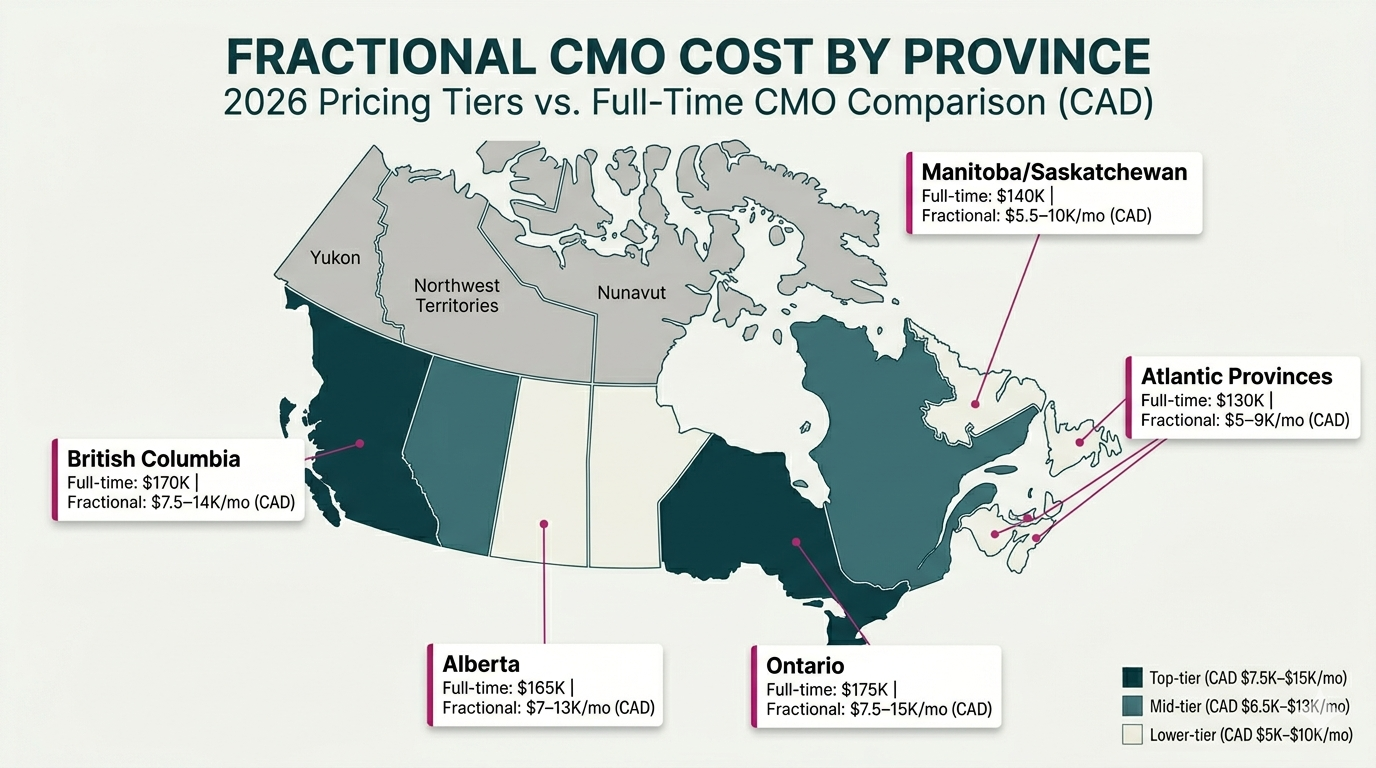
How much does a fractional CMO cost in Canada? By province
Canadian fractional CMO pricing follows a similar pattern. Multi-source consensus shows:
- Ontario — fractional retainers CAD $7,500–$15,000/month; hourly CAD $300–$500
- British Columbia — retainers CAD $7,500–$14,000/month; hourly CAD $300–$500
- Alberta — retainers CAD $7,000–$13,000/month; hourly CAD $275–$475
- Quebec — retainers CAD $6,500–$12,000/month; hourly CAD $275–$450
- Manitoba / Saskatchewan — retainers CAD $5,500–$10,000/month; hourly CAD $250–$400
- Atlantic provinces — retainers CAD $5,000–$9,000/month; hourly CAD $225–$385
The Canadian fractional CMO market is younger than the US market — mainstream adoption only began around 2022 — and pricing is still settling. For Canadian B2B owners researching options, Best B2B Marketing Agencies with Fractional CMO Services in Canada breaks down the providers worth considering.
My honest opinion: most B2B service businesses under $20M shouldn’t hire a full-time CMO
I’ve worked with B2B service businesses for years. Here’s what I tell every owner and president who asks.
If you’re under $20 million in revenue, hiring a full-time CMO is almost always the wrong move. Not because you don’t need senior marketing leadership — you do. But because the full-time CMO role was designed for businesses that can absorb the cost stack, the four-year turnover cycle, and the long ramp. Most B2B service businesses can’t.
What I see again and again at the $5M to $20M range:
- The owner is doing strategy in the gaps between client work
- Marketing is producing things, but the owner can’t tell whether any of them are working
- Sales is unhappy because the leads coming in aren’t qualified
- The agency hired three years ago is busy but not strategic
- The internal marketing person is competent at execution but can’t make the calls about positioning, pricing, or category
This is the exact moment business owners think they need a CMO. They almost certainly need one. But not full-time.
A full-time CMO at $400K total cost will:
- Take three to six months to ramp before they can confidently make decisions
- Consume the marketing budget that should be going to programs, not payroll
- Be optimized for problems they were trained to solve in their last role, not yours
- Have a 42% chance of being gone in 18 months
A fractional CMO at $10,000/month will:
- Be productive on strategic decisions in the first 30 days
- Cost roughly a third as much, freeing the rest of the budget for actual marketing work
- Bring pattern recognition from four or five other businesses solving similar problems right now
- Stay for the duration the work actually requires, with structurally lower failure risk
There is a point — usually somewhere between $20M and $50M in revenue — where a full-time CMO starts to make sense again. You have a team large enough to need direct daily management. You have enough strategic decision-making to keep a senior person fully engaged. You can absorb the four-year cycle without it derailing the business.
Below that line, the fractional model isn’t just cheaper. It’s structurally better-fit to what your business actually needs.
If you’re not sure where you fall, start with the Fractional CMO Checklist: 7 Questions to Know If You’re Ready. It’s the diagnostic I walk owners through when they’re trying to decide.
How to know if the price you’re being quoted is fair
Three quick checks.
1. Does the rate match the experience? A fractional CMO quoting $5,000/month with 20 years of B2B experience and a track record of scaled outcomes is either underpricing (which is sometimes a red flag — why aren’t they charging market?) or willing to give you a deal because they want the work. A fractional CMO quoting $15,000/month with 5 years of VP Marketing experience and no track record of scaling is overpricing.
2. Does the scope match the price? $10,000/month for “strategic advisory, one call a week” is high. $10,000/month for “embedded leadership, two to three days per week, owns the marketing scorecard” is fair. Make sure you understand what you’re buying.
3. Is there an end? A fractional CMO who proposes a six-month engagement with defined deliverables and a clear exit point is usually pricing fairly. A fractional CMO who proposes an open-ended retainer with no defined outcomes is pricing for their convenience, not yours.
Frequently asked questions
How much does a fractional CMO cost per month?
In 2026, most fractional CMOs charge $5,000 to $15,000 USD per month for standard retainer engagements (CAD $6,000 to $13,700 in Canada). Heavier embedded engagements run $15,000 to $50,000+ per month, typically for larger companies or PE portfolio companies.
How much does a fractional CMO cost per hour?
Fractional CMO hourly rates in 2026 range from $200 to $500 USD per hour ($275 to $685 CAD). Senior practitioners with 20+ years of experience and specialized industry expertise charge $300 to $500. Top-tier specialists in B2B SaaS, fintech, or PE-portco work can charge $400 to $750.
Is a fractional CMO cheaper than a full-time CMO?
Yes, significantly. A full-time CMO costs $275,000 to $500,000+ annually in total compensation including salary, bonus, benefits, payroll taxes, and equity. A fractional CMO at $10,000 per month annualizes to $120,000 per year for equivalent strategic horsepower. Most companies save 40% to 70% on total cost — and avoid the four-year turnover cycle entirely.
What is included in a fractional CMO retainer?
Typical fractional CMO retainers cover strategic planning, team leadership, campaign oversight, executive reporting, and quarterly KPI accountability. They typically do not cover ad spend, agency fees, content production, or paid media — those remain separate line items. The retainer pays for the leadership, not the execution.
How long does a fractional CMO engagement last?
The average fractional CMO engagement lasts 71 months — about six years (Geisheker & Associates, 2026). This is significantly longer than the average full-time CMO tenure of 4.1 years (Spencer Stuart, 2026), partly because fractional engagements have fewer structural ways to fail.
Should my B2B service business hire a fractional CMO or a full-time CMO?
If your company is between $2M and $20M in annual revenue, a fractional CMO is almost always the right choice. Above $20M revenue with a complex marketing function, the answer might be a hybrid: a fractional CMO running strategy plus a full-time VP of Marketing managing execution. Above $50M, a full-time CMO is more often justified. The Fractional CMO Checklist is the fastest way to figure out where you fall.
How much does a fractional CMO cost in Canada?
Canadian fractional CMO retainers run CAD $6,000 to $13,700 per month for standard engagements. Hourly rates are CAD $275 to $685. Ontario and British Columbia tend to be at the upper end of the range; Atlantic provinces and the Prairies at the lower end.
Sources
- Salary.com, Chief Marketing Officer Salary, US benchmarks by state, April 2026
- PayScale, CMO Salary Data, US and Canada, 2026
- Glassdoor, Fractional CMO Salary Reports, US and Canada, April 2026 (Canada n=178)
- Spencer Stuart, CMO Tenure Study, 2008–2026 annual series
- Forrester, State of Business Buying, 2024 and 2026
- EY, Private Equity Pulse Survey, 2024
- Geisheker & Associates, Fractional vs. Full-Time CMO Performance Survey, 500+ companies, 2026
- Built In, CMO Salary Data, 2026
- Multi-source rate consensus from Fractionus, Go Fractional, MarketerHire, Geisheker Group, Growtal, MultiplyCMO, O-CMO, and Algocentric Digital, 2025–2026
Related reading on Start Some Shift
- The $175K Question: Why Smart Businesses Are Cutting Executive Costs by 50% Before the Recession Hits — the deeper economics of executive cost-cutting
- Fractional CMO Checklist: 7 Questions to Know If You’re Ready — the diagnostic for whether fractional fits your business
- Fractional CMO vs Marketing Agency vs Brand Strategist – What Do You Need, and When? — how to choose the right kind of help
- Best B2B Marketing Agencies with Fractional CMO Services in Canada — the buyer’s guide for Canadian B2B owners
- B2B Marketing Case Studies — the full Spakinect and Barker Hutchinson stories, plus more
About the Author
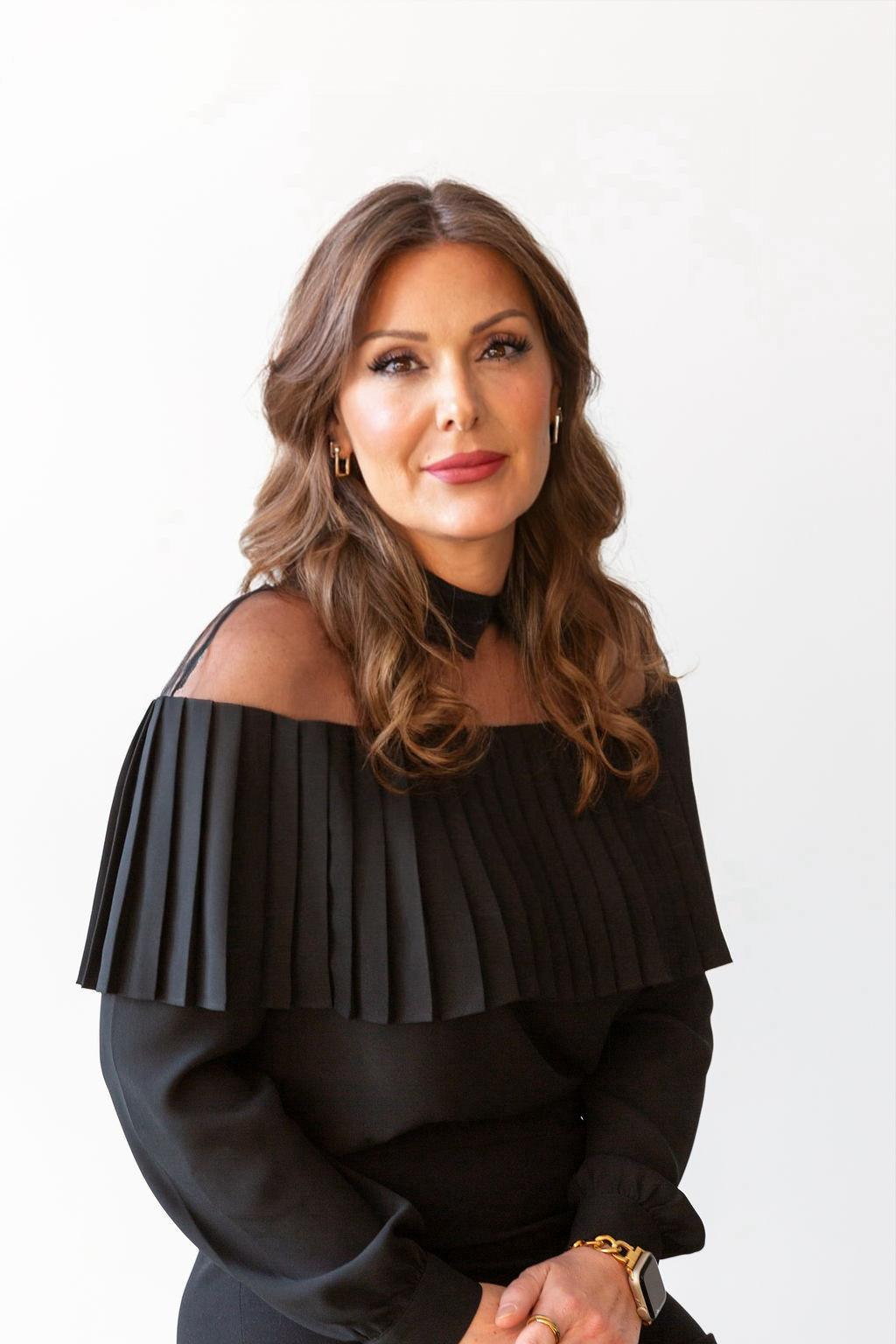
Lara McCulloch is the founder of Start Some Shift, a Toronto-based B2B marketing agency and fractional CMO practice. She works with B2B companies to build brands that are visible, credible, and trusted — to both the algorithms that surface them and the humans who ultimately choose them. startsomeshift.com
Do you like this post?
Ready to explore how fractional leadership could transform your business?
Start Some Shift specializes in helping companies navigate exactly this transition – building flexible, powerful leadership teams that drive growth without breaking the bank. Because in uncertain times, the companies that win are the ones that deploy executive talent most strategically.